Can an All-Black Gym Wardrobe Actually Survive a Full Year?
Quick Answer: Black activewear fades in three different directions depending on fabric — nylon goes brown-ish, polyester goes grey, and cotton blends go soft charcoal. A rotation that still matches after a year needs pieces from the same fabric family, washed cold, dried in air, and replaced as a group rather than one at a time. The fading isn’t preventable. Matching it is.
You built the all-black wardrobe for a reason. Everything goes with everything, nothing needs a decision at 6am, and it looks sharper than it has any right to.
Then around month eight you catch yourself in a mirror and two of the blacks are clearly not the same black anymore. Nothing is worn out. It just stopped being a wardrobe and became a pile of similar dark items.

Why does black activewear fade in different colors?
Because the dye and the fiber are doing different chemistry.
Polyester is dyed with disperse dyes that sit inside the fiber. They’re relatively stable, so polyester holds black longer — but when it does go, it goes evenly grey, like the whole garment stepped back a shade.
Nylon takes acid dyes, which bond differently and are more vulnerable to chlorine, sunlight, and body oils. Nylon-heavy pieces tend to shift warm — a brownish or faintly reddish cast that’s invisible alone and obvious next to a true black.
Cotton blends fade fastest and most visibly, going soft and chalky at the seams and high-friction spots first.
That’s the whole problem in one sentence: three pieces bought on the same day in the same black will be three different colors in a year, and it has nothing to do with quality.
What actually causes the fade — washing or wearing?
Both, but not in the ratio most people assume.
Heat is the biggest single factor, and most of it comes from the dryer, not the wash. A hot tumble dry does more damage in one cycle than several cold washes. It degrades the elastane at the same time, so the piece loses both its color and its shape on the same schedule.
Body oils and sweat are second, and they’re why the fade is never even. Waistbands, underarms, and the inside of the thigh go first because that’s where the oil and friction concentrate. This is also why rinsing a piece soon after a heavy session matters — sweat left to dry in the fabric keeps working on the dye.
UV is third and it’s sneakier than it sounds. Drying black leggings on a sunny balcony is efficient and it is also bleaching them. Air-dry in shade or indoors.
Detergent matters less than the internet suggests, with one real exception: anything containing optical brighteners will dull black over time. Check the label for the word brightening and avoid it.
Myth vs Fact: Keeping Black Black
Myth: Washing black clothes in cold water with vinegar sets the dye. Fact: Vinegar helps rinse detergent residue, which can make a piece look slightly darker. It doesn’t set anything. The dye was set at the mill.
Myth: Turning garments inside out is a fussy step that doesn’t matter. Fact: It genuinely does, and it’s free. The outside of the fabric is what abrades against the drum. Inside out means the wear happens on the surface nobody sees.
Myth: Expensive black activewear doesn’t fade. Fact: It fades on a slower curve, not a different one. What you’re buying at higher price points is usually better recovery and construction, not immortal dye.
Myth: You can re-dye faded activewear at home. Fact: Almost never successfully. Home dyes are formulated for natural fibers; synthetics need heat levels that destroy the elastane. You’ll get a patchy piece that also no longer stretches.
Myth: Fading means the piece is worn out. Fact: A faded legging can be structurally perfect. It’s just no longer part of the matching system — which is a wardrobe problem, not a garment problem.
How do you build a rotation that ages together?
The trick is treating your blacks as a cohort, not as individual purchases.
Buy in groups. Two to three bottoms at once, from the same brand and the same fabric family, so they start identical and age on the same curve. When one is done, they’re all close to done, and you replace the group.
Separate by role. Your high-sweat pieces — bras, tight tanks — fade fastest, so don’t expect them to match your bottoms after month six. Either accept that and let tops be slightly-off black, or plan for tops to be replaced twice as often.
Keep one reference piece that never gets worn hard. A pair of black leggings you only wear for low-sweat sessions is your color benchmark. Hold a questionable piece next to it in daylight and you’ll know immediately.
And stagger the good stuff. The newest, truest black should be the piece that’s most visible — the outer layer, the piece worn without anything over it. Older blacks go underneath, where the shift doesn’t read.
What’s the realistic lifespan?
With cold washing, air drying, and normal use, here’s what to plan for:
- Leggings and bottoms: 12 to 18 months as a true black, longer as a wearable piece. High-friction inner thigh usually goes first.
- Sports bras: 8 to 12 months. Highest oil exposure, most washes, and the band elastic dies around the same time the color does — which is convenient.
- Tops and tanks: 12 months if worn under something, 8 if worn alone in the sun.
- Outer layers: 2 years or more. They rarely touch sweat directly.
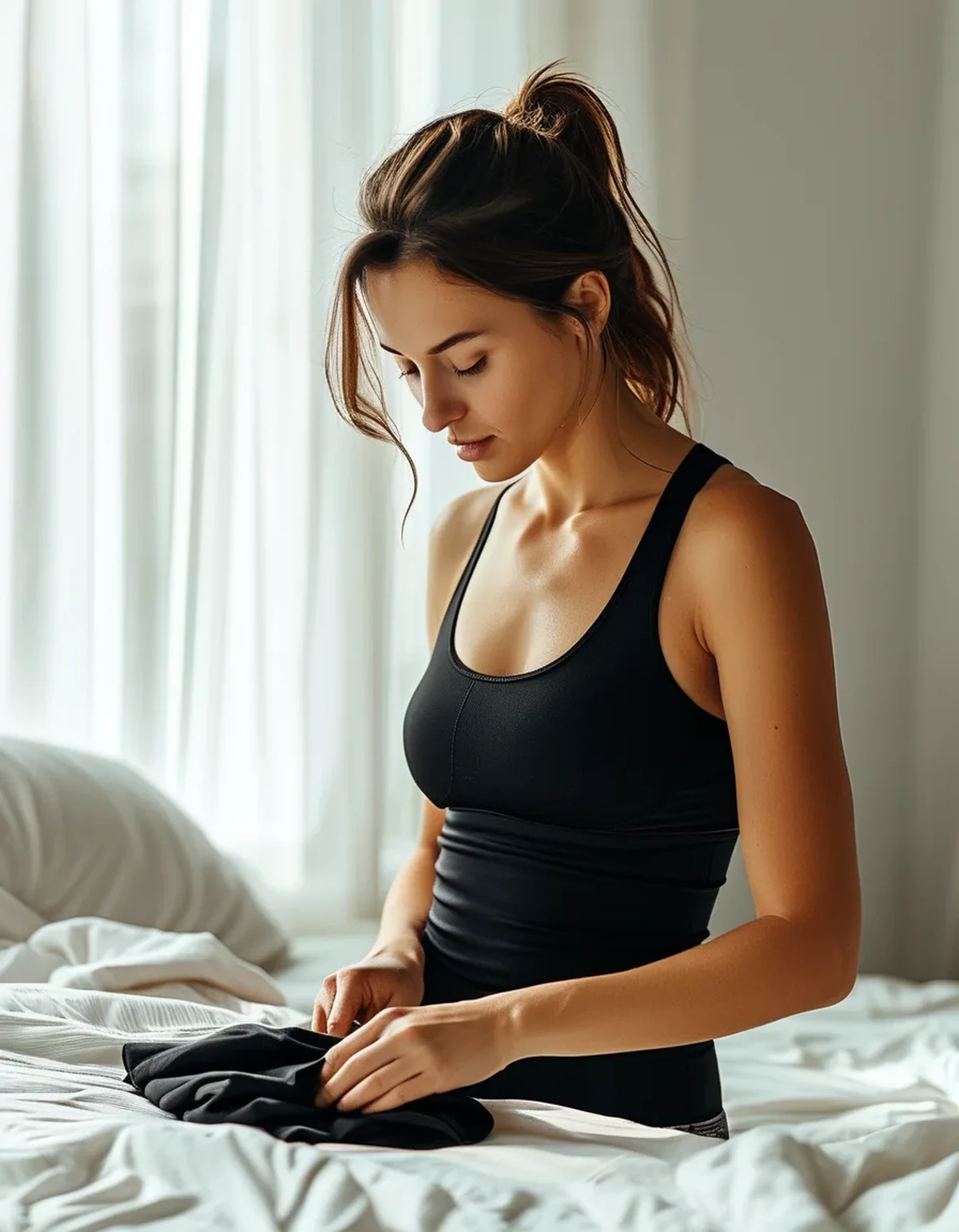
Heading into fall is actually the right moment to audit. Sessions move indoors, sweat load per session often goes up rather than down, and you’re about to put the whole rotation through a heavier six months. Lay everything on a white bed in daylight — not under bathroom light, which flatters everything — and sort into three piles: true black, drifted, and done.
The drifted pile isn’t garbage. It’s your under-layer wardrobe for the next year.
FAQ: All-Black Activewear Questions, Answered
Does washing black separately from other colors actually help?
It helps for a different reason than people think. It’s not about dye transferring onto the black — it’s about lint. Light-colored cotton sheds fibers that cling to black synthetics and read as a grey haze that survives the dryer.
Is there a detergent worth buying for dark activewear?
A sport-specific or dark-specific liquid without brighteners, used at half the recommended dose. Overdosing detergent is more common than underdosing, and the residue is what makes black look dusty.
My leggings look black indoors and brown outside. Which is real?
Outside. Daylight has a fuller spectrum and shows the true cast; indoor bulbs are warm and hide a warm drift. Always judge black in daylight, near a window, against a white surface.
TL;DR:
- Black fades differently by fiber — polyester to grey, nylon to warm brown, cotton blends to chalky.
- Heat is the main culprit, and most of it comes from the dryer. Cold wash, air dry, out of direct sun.
- Buy blacks in cohorts from the same fabric family so they age together and get replaced together.
- Keep one lightly-worn reference piece and judge everything against it in daylight.
- Plan for roughly 12–18 months on bottoms, 8–12 on bras. Drifted pieces become under-layers, not garbage.
An all-black wardrobe doesn’t fail because pieces wear out. It fails because they stop agreeing with each other — and that’s a buying pattern you can fix.
See It in Motion
Seen here: High Waist Yoga Leggings with Side Pockets — shop it on bubblelime.com
Keep Reading
This article is for general informational and styling purposes only. Fit, sizing, and product availability may vary.